
Professional customized avocado processing equipment&solutions

Kenya has firmly established itself as a global powerhouse in avocado production, with its rich, buttery Hass variety being a particular favourite in European and Middle Eastern markets. But have you ever wondered how these delicate fruits survive a long journey across the ocean, arriving in supermarkets perfectly ripe and unbruised? The secret lies in a sophisticated and carefully designed packaging system.
It’s not just about putting avocados in a box; it’s a science dedicated to preserving quality from the farm to the foreign shelf. Let’s unpack the layers of this crucial process.
The first line of defence is the corrugated fibreboard carton. This is no ordinary box. It’s specifically designed to be strong, lightweight, and ventilated.
Standardisation: Kenyan exporters primarily use the 4kg or 5kg carton, a standard size that is easy to stack, handle, and fits perfectly on international pallets. Common dimensions are tailored to hold a specific count of fruits—for example, 8, 10, 12, or 14 avocados per box, indicating the size and grade of the fruit inside.
Ventilation is Key: You’ll notice these cartons are peppered with holes. These ventilation holes are critical for temperature management and allowing ethylene gas (which ripens the fruit) to escape during refrigerated shipping, preventing the avocados from ripening too quickly.
Inside the carton, each avocado is cradled to prevent them from knocking against each other. This is where the real magic happens.
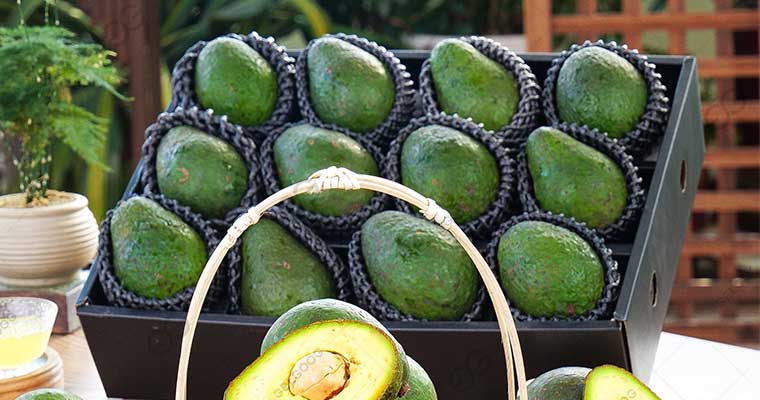
Moulded Trays: The most common method involves using single-layer trays made of moulded pulp or plastic. Each fruit sits snugly in its own cup-shaped cavity. This design absorbs shock and distributes pressure, preventing bruising and punctures.
Specialised Liners: For premium fruit, you might find soft, foam-net sleeves placed around each avocado before they are nestled into the trays. This adds an extra layer of cushioning and protection against abrasions.
Before an avocado even touches the packaging, it undergoes rigorous preparation. Kenyan exporters follow strict protocols set by the Kenya Plant Health Inspectorate Service (KEPHIS) and international market standards.
Harvesting at the Right Time: Avocados are harvested mature but unripe (hard). This ensures they can withstand the journey and ripen at their destination.
Careful Washing and Sorting: After harvest, the avocados are gently washed to remove any field dirt. They are then sorted by size, weight, and quality. Any fruit with blemishes, cuts, or signs of disease is rejected.
Hot Water Treatment (HWT): To meet phytosanitary requirements of countries like South Africa and China, the avocados undergo a mandatory Hot Water Treatment. This process involves dipping the fruit in water at a controlled temperature to eliminate any potential fruit fly larvae, a key concern for importing nations.
Once packed, the cartons are stacked on standard pallets, secured with straps or stretch wrap to create a stable unit for shipping. The most critical phase then begins: the cold chain.
The pallets are immediately moved into refrigerated containers (reefers) set at a precise temperature, usually between 4-7°C. This controlled environment puts the avocados into a state of suspended animation, slowing down their metabolism until they reach their final destination.
In essence, the packaging for Kenyan avocados is a holistic system. It’s a combination of a sturdy carton, intelligent internal design, meticulous fruit preparation, and an unbroken cold chain. This intricate process is a testament to Kenya’s commitment to quality, ensuring that when you buy a Kenyan avocado, you’re getting a product that has been cared for every step of the way. It’s this attention to detail that keeps Kenya at the forefront of the global avocado trade.
 +86 18595613260
 skena@gelgoog.com