
Professional customized avocado processing equipment&solutions

Avocados are a nutritional powerhouse, but their notoriously short shelf life is a constant challenge. For food manufacturers, this is where frozen avocados come in. They offer year-round availability, consistent quality, and reduced waste, making them the secret ingredient for everything from smoothies and guacamole to spreads and bakery items.
But how do you take a delicate, perishable fruit and turn it into a reliable, frozen ingredient? The process is a carefully controlled dance of speed, temperature, and technology. Let’s walk through the key stages of industrial avocado processing.
Step 1: Sourcing and Receiving
It all starts with quality. Industrial processors source avocados, primarily the Hass variety, from trusted growers. The fruit is harvested at the perfect "breaking" stage of maturity—not too hard, not too soft. Upon arrival at the facility, the avocados are rigorously inspected. They are washed and sanitized to remove any dirt, pesticides, and surface microbes. This initial step is critical for ensuring food safety from the very beginning.
Step 2: Preparation: Pitting, Peeling & Slicing
The clean avocados move to the preparation line. Here, automation takes over. Machines efficiently slice the avocados in half and remove the pits. The skin, which is not typically used in frozen products, is mechanically peeled away.
Depending on the customer's needs, the avocado flesh is then cut into specific forms:
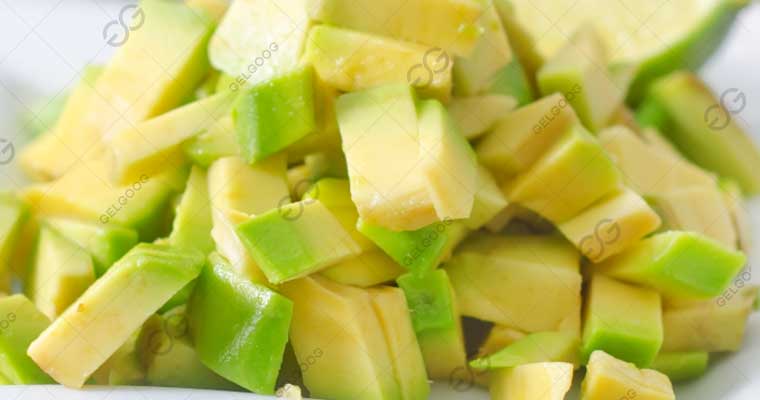
Diced/Cubed: Ideal for salsas, salads, and as toppings.
Sliced: Perfect for sandwiches and burgers.
Mashed/Pureed: The base for guacamole, dips, and smoothies.
Step 3: The Critical Step: Quick Freezing (IQF)
This is the most important part of the process. To preserve the avocado's vibrant green color, creamy texture, and fresh flavor, processors use a method called Individual Quick Freezing (IQF).
The prepared avocado pieces are spread out on a conveyor belt and travel through a blast freezer. Here, they are exposed to extremely cold, circulating air (around -30°C to -40°C / -22°F to -40°F). This rapid freezing is crucial because it prevents the formation of large ice crystals. Large crystals can puncture the avocado's cell walls, leading to a mushy, discolored mess when thawed. IQF locks in the quality by creating tiny ice crystals, ensuring each piece remains separate and intact.
Step 4: Coating and Additives (For Quality Preservation)
To combat oxidation—the natural enemy of avocados that causes browning—a light coating is often applied before freezing. This is typically a harmless, food-grade solution like ascorbic acid (Vitamin C) or citric acid. This simple step acts as an antioxidant, effectively putting a "shield" around the avocado to maintain its appealing green hue for months.
Step 5: Packaging and Storage
The IQF avocado pieces are now ready for packaging. They are weighed and packed into large, airtight bags—often within cardboard boxes or directly into bulk bags. These packages are designed to be moisture-proof and resistant to freezer burn. Finally, the product is moved to a cold storage warehouse, where it is kept at a consistent, deep-freeze temperature until it is shipped to food manufacturers around the world.
The Final Product
The result is a versatile, high-quality ingredient that delivers the fresh taste and nutrition of avocado with industrial convenience. For food brands, this means consistent product quality, simplified production, and the ability to create avocado-based products any time of the year.
 +86 18595613260
 skena@gelgoog.com